

Welcome to your home buying journey! The mortgage pre-approval process might seem challenging at first. But it’s your secret weapon in competitive housing markets.
Think of pre-approval as a financial trial run. It sets the foundation for your home search. This step helps you understand what you can afford before you start house hunting.
Getting pre-approved shows sellers you’re a serious buyer. It proves you have verified financial backing. This gives you a competitive edge when making offers on your dream home.
This guide will walk you through each stage of the mortgage pre-approval process. You’ll learn how to position yourself as a strong buyer. And you’ll confidently navigate your home purchase.
The Importance of Pre-Approval
Getting pre-approved for a mortgage makes you a serious homebuyer. It gives you real power to buy a home. This step is key in the loan approval process.
In hot markets, your pre-approval letter stands out. Sellers see you as a serious buyer. This can make your offer more attractive than others.
The pre-approval process makes finding a home easier. You know exactly how much you can spend. This saves time by focusing on homes you can afford.
With pre-approval, you have more negotiating power. Sellers are more likely to consider your offers. This can lead to better deals and save you money.
Pre-approval speeds up the closing process. Much of the paperwork is done early. This is a big advantage when competing with other buyers.
Real estate agents take pre-approved buyers seriously. They know you’re ready to act fast. This can lead to better service and more attention.
Pre-approval is about confidence and being ready to act. It shows you’re serious in the loan approval process.
What Lenders Are Looking For
When you apply for mortgage preapproval, lenders check your financial details. They want to make sure you can pay your mortgage on time. They also look at your other financial duties.
Lenders focus on four main things: your credit history, income, debt, and assets. Knowing these areas helps you get ready for the application. It also boosts your chances of getting approved.

Your credit score is like a financial report card. Lenders like scores of 740 or higher for the best rates. But, scores as low as 620 might get you approved, though rates could be higher.
Lenders examine your credit report for patterns. They look for consistent payments, low credit use, and a mix of credit types. Late payments or collections can hurt your chances.
Income and Employment History
Stable income shows you can make regular mortgage payments. Lenders often want to see two years in the same job or with the same employer. Job hopping might make them worry about your income.
Self-employed people need to provide more proof. They must show steady income through tax returns and profit statements.
Debt-to-Income Ratio
Your debt-to-income (DTI) ratio compares your debt payments to your income. Most lenders aim for a DTI under 36%. But, some might go up to 43% if you have strong points.
To find your DTI, add up all your monthly debt payments. Then, divide by your monthly income. This percentage shows lenders how much you can borrow.
Asset Verification
Lenders check if you have enough money for a down payment and closing costs. They also look for emergency funds that can cover a few months of mortgage payments.
You’ll need to show proof of all your assets. This includes bank statements, investment accounts, and retirement funds. Large deposits need an explanation to prove they’re not borrowed money.
| Factor | Ideal Range | Minimum Requirement | Documentation Needed |
|---|---|---|---|
| Credit Score | 740+ | 620 | Credit report authorization |
| Debt-to-Income Ratio | Below 36% | Below 43% | Pay stubs, tax returns |
| Employment History | 2+ years stable | 1 year minimum | Employment verification |
| Cash Reserves | 3-6 months payments | Down payment + closing | Bank statements |
Remember, each lender has different needs. Some might focus more on certain things. The required documents help lenders check your financial situation.
Having these required documents ready makes the process smoother. It shows lenders you’re serious about buying a home. Being prepared shows you’re financially responsible, which lenders value.
Documents You’ll Need
Gathering your paperwork is a key step in the mortgage pre-approval journey. It might seem tough at first, but being organized makes it easier.
Lenders check your financial health and identity. They want to make sure you can pay your mortgage on time.
- Proof of income – Recent pay stubs, W-2 forms, and tax returns
- Asset documentation – Bank statements and investment account records
- Identification – Government-issued ID and Social Security number
- Debt information – Current loan statements and credit obligations
Self-employed folks need extra papers. Business tax returns and profit/loss statements show steady income.
Getting ready ahead of time saves you time. Use a folder, physical or digital, to keep everything in one place. Lenders often ask for the last 2-3 months of statements.
For a detailed list of needed documents, visit this mortgage pre-approval documentation resource.
| Document Type | Specific Items | Purpose |
|---|---|---|
| Income Verification | Pay stubs, W-2s, 1099s | Proof of stable earnings |
| Tax Documents | Tax returns (2 years) | Income history verification |
| Asset Statements | Bank/Investment accounts | Down payment capability |
| Identification | Driver’s license, SSN | Identity confirmation |
| Debt Records | Loan statements | Debt-to-income ratio calculation |
Each document tells a part of your financial story. Accurate paperwork helps lenders make quick decisions.
The mortgage pre-approval process is easier when you’re ready. Being prepared shows lenders you’re serious about buying a home.
The Pre-Approval Application Process
Getting your mortgage pre-approval is easier than you think. It’s like a step-by-step guide where you collect your financial info and share it with lenders. This step shows you how much you can borrow and proves to sellers you’re serious.
First, look for different lenders. You can choose from banks, credit unions, or online mortgage services. Each offers unique rates and terms. By comparing, you find the best match for your finances.
When you’re ready, fill out the lender’s form. You’ll give basic info and agree to a credit check. Most lenders use online forms that are fast and secure.
Here’s what happens next:
- Lenders check your credit report and score
- They confirm your job and income
- They look at your debts and assets closely
- They check all your documents carefully
This detailed check makes sure your application is accurate. Lenders want to be sure you’re financially stable before moving ahead.
Smart application strategy: Apply to all lenders within 45 days. This way, only one credit check is recorded on your report. It lets you compare offers without hurting your score too much.
Knowing about credit inquiries helps you. Soft pulls don’t affect your score and are often for initial checks. Hard inquiries happen when you apply formally and can slightly lower your score.
Processing times vary from a few days to a week. Online lenders might offer same-day pre-approvals, while traditional banks take longer. The complexity of your finances also plays a role.
| Application Stage | Time Required | What Happens |
|---|---|---|
| Initial Application | 20-30 minutes | Submit personal and financial information |
| Document Review | 1-3 business days | Lender verifies all submitted materials |
| Credit Assessment | Same day as application | Credit report pulled and analyzed |
| Pre-Approval Issuance | 1-2 days after verification | Letter generated with loan amount and terms |
After approval, you get a pre-approval letter. It shows your loan amount, interest rate, and when it expires. This letter is a strong tool for house hunting, usually valid for 60-90 days.
Remember, pre-approval isn’t a final loan agreement. It’s based on initial info and subject to property appraisal and final review. But it helps you make strong offers with confidence.
Keep your documents ready throughout the process. Quick responses to lender requests can speed things up. Being proactive ensures a smooth journey through your loan approval process.
Understanding Your Budget
Your mortgage pre-approval amount is the max you could borrow. But, smart buyers think about what they should spend. This choice can make all the difference between stress and happiness in homeownership.
Think of your pre-approval as the starting line, not the finish line. The number your lender gives you is a good start. But, your real budget should show your full financial situation and lifestyle.
Your mortgage payment is just one part of owning a home. Other costs will also affect your budget and how much you can afford:
| Cost Category | Typical Range | Payment Frequency | Impact on Budget |
|---|---|---|---|
| Property Taxes | 1-2% of home value annually | Monthly (escrow) | Significant – varies by location |
| Homeowners Insurance | $100-$200 monthly | Monthly (escrow) | Moderate – depends on coverage |
| Private Mortgage Insurance | 0.5-1% of loan annually | Monthly | Significant – if down payment |
| HOA Fees | $200-$500 monthly | Monthly | Variable – community dependent |
| Maintenance & Repairs | 1% of home value annually | As needed | Essential – budget monthly |
Online mortgage calculators are great for estimating your monthly payment. Just enter your home price, down payment, interest rate, and loan term. The calculator will show your principal and interest, then add estimates for taxes and insurance.
Remember to consider your debt-to-income ratio (DTI) when planning your budget. Most lenders want a DTI below 43%. But, you might prefer a lower percentage to save for the future and unexpected costs.
Your required documents help set your budget foundation. Your income verification, bank statements, and debt info help figure out your monthly payment limit.
Ask yourself these important questions when setting your comfort zone:
- What monthly payment allows me to maintain my desired lifestyle?
- How much should I set aside for retirement and other financial goals?
- What emergency fund cushion do I need to feel secure?
- Are there upcoming life changes that might affect my income?
Many buyers find they’re most comfortable spending 20-30% less than their pre-approval amount. This extra room makes owning a home more enjoyable and financially stable.
The required documents process is more than just qualifying for the max. It’s about understanding what you can really afford while keeping your finances healthy and your mind at ease.
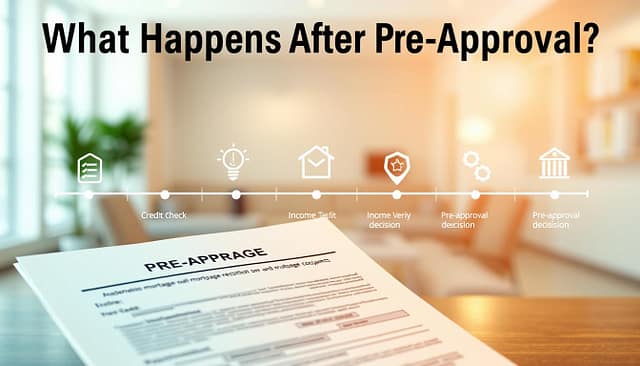
What Happens After Pre-Approval?
Now that you have your pre-approval letter, it’s time to start looking for homes. This is an exciting step in your journey. But, knowing what comes next will help you stay on track.
Your pre-approval letter is good for 60-90 days. This gives you time to find the right home without feeling rushed. If you need more time, you can usually renew your pre-approval by updating your financial info.
When you find your dream home, use your pre-approval letter with your offer. This shows sellers you’re serious and have financing ready. Sellers often prefer offers from pre-approved buyers because they’re more likely to close.
Remember: pre-approval isn’t a final loan guarantee. Your lender will check the property value and your finances again before closing. So, keep your finances stable throughout the process.
Here are some tips to keep your finances in check after pre-approval:
- Keep your job stable – avoid changing employers
- Maintain your credit score – don’t open new credit accounts
- Avoid large purchases – don’t use credit for big buys
- Keep cash reserves available – don’t spend all your savings
- Continue paying bills on time – keep your payment history good
If your financial situation changes, tell your lender right away. Changes like salary increases, new debt, or credit score drops can affect your approval.
The mortgage loan process has more steps after pre-approval. You’ll need a home appraisal, title search, final underwriting, and closing prep.
| Pre-Approval Stage | Final Approval Stage | Key Differences |
|---|---|---|
| Based on initial documentation | Requires verified documentation | Final verification of all information |
| Property not yet identified | Specific property appraisal required | Home must meet value requirements |
| Good faith estimate provided | Final loan terms locked | Rates and terms become definite |
| Conditional approval | Unconditional commitment | No outstanding conditions remain |
Having a pre-approval is a great start to buying a home. But, the journey is not over. Stay financially consistent, talk to your lender, and you’ll get to closing day smoothly.
Troubleshooting Denials
Getting denied for mortgage pre-approval can be tough. But it’s not the end of your home buying dreams. Many people face this hurdle and succeed with the right steps. Knowing why you were denied is key to fixing it.
Lenders check several things during the loan approval process. Reasons for denial include bad credit, high debt, job gaps, or missing documents. Each problem has a solution to get you back on track.
Your credit score is very important in the loan approval process. A low score means you’re seen as a higher risk. To improve, pay bills on time, reduce credit card balances, and fix any credit report errors.
Your debt-to-income (DTI) ratio is also important. Lenders want it below 43%. If it’s higher, pay down debts before applying again. Even small reductions can help a lot.
Employment history is key too. Lenders want to see stable income. If you’ve changed jobs or have employment gaps, you might need to wait. Some lenders help with unique employment situations.
Fixing documentation issues is often easy. Make sure your paperwork is complete and accurate. Double-check everything before submitting. Missing documents can slow down or stop your pre-approval application.
If you get a denial, ask the lender why. They must tell you under federal law. Use their feedback to make a plan to improve. Most issues can be fixed in 3-6 months.
Consider working with specialized lenders for complex situations. Some focus on borrowers with past credit issues or non-traditional income. Government-backed loans like FHA or VA often have more flexible rules.
Remember, denial isn’t permanent. Many successful homeowners were initially denied pre-approval. With patience and the right plan, you can improve your finances and try again. For more specific advice, check out these common preventable reasons for mortgage denials.
| Common Denial Reason | Quick Fix Strategy | Typical Timeline | When to Consider Alternatives |
|---|---|---|---|
| Low Credit Score | Dispute errors, pay down balances | 3-6 months | Score below 580 |
| High DTI Ratio | Pay off debts, increase income | 2-4 months | Ratio above 50% |
| Employment Gaps | Establish 6-month employment history | 6 months | Self-employment or commission income |
| Documentation Issues | Organize paperwork, verify accuracy | Immediate | Complex tax situations |
Stay positive during the loan approval process. Setbacks are normal, but they don’t mean you can’t own a home. Focus on one problem at a time and celebrate small wins.
Your dream home is within reach. With determination and the right strategy, you can overcome pre-approval challenges and move forward with confidence.
Pre-Approval FAQs
How does mortgage pre-approval affect my credit score?
Getting pre-approved might lower your credit score a bit. But, many checks in 45 days are counted as one. This is a small, temporary drop.
What’s the typical timeline for getting pre-approved?
It usually takes a few days to get pre-approved. Some lenders can make quicker decisions if you provide all needed documents fast.
What required documents do lenders need for pre-approval?
Lenders need recent pay stubs, W-2 forms, tax returns, bank statements, and ID. Having these ready can make the process faster.
How much income do I need for different loan amounts?
Lenders look for your monthly housing payment to be 28% or less of your income. This rule changes based on the loan type and your debt-to-income ratio.
What’s the difference between pre-approval and pre-qualification?
Pre-qualification is a quick guess based on what you tell them. Pre-approval, on the other hand, involves real checks on your finances. It’s more convincing to sellers.
Can I get pre-approved with less-than-perfect credit?
Yes, many lenders accept different credit levels. Some government-backed loans are more flexible than regular mortgages.