

Forget your credit score for a second. There’s a more primal number lenders use to size you up. It’s your financial BMI, the gatekeeper standing between you and that coveted pre-approval letter. We’re talking about your debt-to-income ratio, or DTI.
In plain English, your DTI is the percentage of your monthly gross income that gets devoured by existing debt payments. Think student loans, car notes, and credit card minimums. Lenders aren’t just being nosy; they’re running a stress test on your budget.
If too much of your cash flow is already spoken for, adding a mortgage might be the fiscal equivalent of trying to sprint with a weighted vest. This isn’t abstract math. In 2022, a high DTI was the most common reason for mortgage denial.
Understanding what this number means is your first move in learning how to game the system. Let’s cut through the jargon.
Front-end vs back-end ratios
The mortgage approval process has a good cop, bad cop feel. The front-end ratio is the nice part, asking if you can handle the mortgage payment. The back-end ratio is tougher, looking at all your current debts.
The front-end ratio, or housing ratio, is about your future. It only looks at your mortgage payment. This is a simple question about your ability to pay.
Think of the front-end ratio like telling a personal trainer you’ll work out three times a week. They might seem okay with it, but they’re not sure.
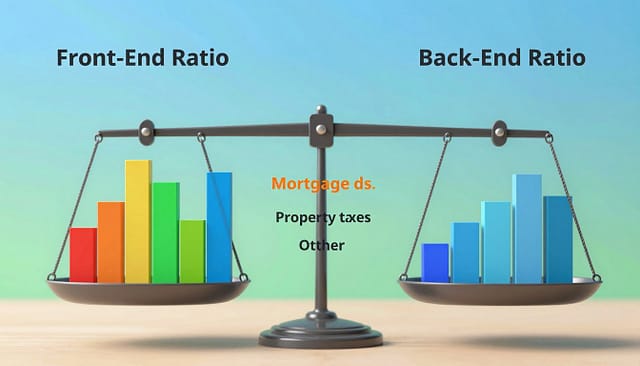
The back-end ratio is a deeper look at your finances. It checks all your monthly payments, including your mortgage, car, and student loans. It even looks at credit card payments and alimony.
This ratio shows the real state of your finances. Lenders pay more attention to it. The back-end ratio is more important because it shows your current financial situation.
Here’s how it works. The front-end ratio divides your future mortgage payment by your income. The back-end ratio divides all your monthly payments by your income. This simple math has big implications.
The industry has set “gold star” benchmarks. For the front-end ratio, aim for 28% or less. For the back-end ratio, aim for 36% or less. Meeting these goals shows you’re financially fit.
Think of it like this: the 28% front-end limit means you won’t be house-poor. The 36% back-end limit means you have room for other expenses.
Going over these percentages means you’re taking on too much risk. You become a risk for the bank, not just a loan qualification success.
Lenders use these ratios because they’ve seen it all. They know someone can technically afford a mortgage but is actually drowning in debt. The back-end ratio reveals this truth.
Managing both ratios is your goal. But focus more on the back-end. Reducing your total debt is key to loan qualification. It improves both ratios.
In the mortgage approval show, the front-end ratio is the opening act. It’s nice but forgettable. The back-end ratio is the main event. It decides if you get approval or not.
How lenders calculate DTI
Think of the DTI calculation as a three-act financial drama. You’re the star, your bank statements are the script, and the final percentage is your review score. Let’s pull back the curtain.
Act One is the Debt Inventory. This isn’t about your daily Starbucks run. Lenders want to see your contractual, monthly obligations. Grab your statements and a highlighter.
| Debts That Count | Expenses That Don’t |
|---|---|
| Mortgage or Rent Payment | Utilities (Electric, Water, Gas) |
| Auto Loan/Lease Payments | Groceries & Dining Out |
| Student Loan Minimums | Insurance Premiums (Car, Health) |
| Credit Card Minimum Payments* | Streaming Subscriptions & Gym Memberships |
| Alimony or Child Support | Gasoline or Public Transit Costs |
*Yes, even if you pay the full balance every month. The lender looks at the required minimum. That “Buy Now, Pay Later” plan for your new gadget? Annoyingly, it counts too.

Act Two is Income Reconnaissance. This is your gross monthly income—the big, beautiful number before taxes perform their magic trick of making it vanish. Include your salary, side-hustle revenue, rental income, and regular bonuses. Now is not the time for modesty.
Act Three is where the simple, often soul-crushing, math happens. Here’s your script:
- Sum all your monthly debts from Act One.
- Determine your total gross monthly income from Act Two.
- Divide your total monthly debts by your gross monthly income.
- Multiply that result by 100 to get your DTI percentage.
The formula looks like this: (Total Monthly Debts / Gross Monthly Income) x 100 = Your DTI%.
But here’s the final plot twist for a DTI mortgage application. When the lender runs this calculation, they insert your projected new mortgage payment—principal, interest, taxes, and insurance (PITI)—right at the top of your debt column. They’re stress-testing your future budget, not just auditing your past.
So, your pre-approval DTI is a snapshot of you plus a hypothetical house payment. It’s a brutally honest mirror held up to your financial future.
Reducing your DTI
That rejection email wasn’t the end of your dream to own a home. It was just the start of a financial battle. Your DTI ratio is your opponent, and you need a plan. This is where strategy meets action.
Think of it as a three-pronged attack. Each part targets the ratio from a different side. The goal is not just better numbers. It’s to strengthen your loan qualification position.
First, let’s talk about making more money. Can you earn extra through a side job? The gig economy isn’t just for young people with scooters. Work overtime or ask for a raise. More money means less debt ratio. It’s simple math.
Every extra dollar you earn fights against a high DTI. A side job isn’t just for pocket money. It’s a powerful tool in your financial fight.
The Debt Blitz
Now, let’s go after the debt you already have. Start with high-interest loans first. This is like fighting the biggest fire first. Credit card debt is your main target.
Look into debt consolidation or a balance transfer card. These can cut your interest rates a lot. Paying extra on the principal is a direct attack on your DTI.
Refinancing can also lower your monthly payments. Lower payments mean a better ratio. It’s that simple.
The Philosophical Pivot
Here’s the hard truth. Consider buying a less expensive home. It might feel like a setback. But sometimes, the smart choice is a starter home, not a dream mansion.
Building equity in a smaller home is better than struggling with a big mortgage. It’s the difference between being house-poor and living a life. A lower mortgage payment is the fastest way to improve your DTI.
Other Strategic Moves
What about getting a co-signer? This is a long shot. Remember, you’re asking someone to take on your financial burden. It makes your application stronger right away. But it’s a big ask.
The key is, a high DTI isn’t forever. You can solve it by making more money, paying off debt, or choosing a smaller home. Often, it’s a mix of all three.
Master these strategies, and you become a financial player, not just an applicant. Your next application won’t just be stronger. It will be almost unbeatable.
Approval benchmarks
So, what’s the magic number for your DTI mortgage approval? Think of lender benchmarks as a velvet rope policy. There’s a list, but the bouncer has some wiggle room.
Conventional loans often follow the 28/36 rule. But, with a great credit score and enough savings, some lenders might go up to 45% or 50%. Government-backed loans, like FHA, VA, and USDA, have their own rules.
The average approved DTI mortgage is around 40%. Many people get loans above the ideal. But, going over 50% can shut doors. Your real benchmark is what you’re comfortable with. Getting approved at 48% might win you a house but might cost your peace of mind.
Use a debt-to-income calculator to find your number before applying. The best rate and the best sleep come from a lower ratio.