

A house with rooftop solar panels can offer lower electricity costs, but the panels may not belong to the homeowner. If the system is leased or covered by a power purchase agreement, a buyer may inherit a long-term payment obligation rather than receive the equipment as part of the purchase.
That distinction can affect monthly expenses, mortgage approval, contract negotiations, and the ability to sell the property later.
Before buying a house with leased solar panels, verify who owns the equipment, what payments remain, and whether the solar provider will approve the ownership transfer.
A solar installation can be a valuable feature. However, lower electricity bills do not automatically mean the underlying agreement is financially beneficial.
Solar Panels Can Come With Three Different Financial Arrangements
The first step is determining how the rooftop system was purchased or financed.
A house can have identical-looking solar panels under very different agreements.
Owned solar panels: The homeowner purchased the equipment outright or previously paid off its financing. The panels may transfer with the house, subject to the applicable ownership and title documents.
Solar lease: A third-party provider owns the equipment. The homeowner generally makes scheduled payments for the right to use the system.
Power purchase agreement (PPA): A solar provider owns the system, while the homeowner purchases the electricity it generates at a contractual rate.
The U.S. Department of Energy’s guide to buying a house with solar panels recommends investigating the system’s age, maintenance history, warranties, production records, and ownership arrangement before purchasing.
It also notes that third-party ownership may require additional steps to transfer the existing agreement.
A buyer should not assume that solar panels are included in the property sale simply because they are permanently mounted on the roof.
The purchase documents and solar contract must establish what is actually transferring.
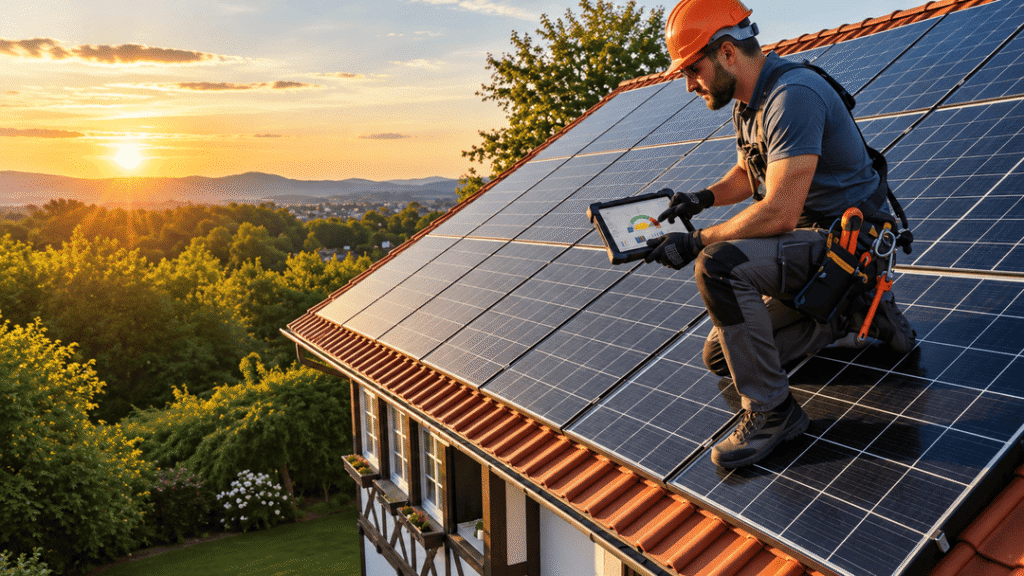
Why a Solar Lease Is Different From a Power Purchase Agreement
Leases and PPAs both allow homeowners to use rooftop solar without owning the equipment, but their payment arrangements differ.
With a solar lease, the homeowner typically pays a recurring amount to the equipment owner.
With a PPA, payments generally depend on how much electricity the system generates and the agreed price per kilowatt-hour.
The distinction becomes especially important when reviewing future costs.
Some agreements include annual price increases, commonly called escalators.
The Consumer Financial Protection Bureau’s research on residential solar financing describes these arrangements and explains how contractual price increases can affect consumers.
The agency’s August 2024 analysis also identifies risks involving confusing financing disclosures, potentially misleading savings claims, and assumptions about future electricity prices.
A contract that appears inexpensive today may cost considerably more later.
For example, suppose a solar lease begins at $120 per month and increases by 3% annually.
Under that hypothetical arrangement, the monthly charge would rise to approximately $157 in year ten.
That calculation assumes one increase at the start of each new contract year, compounded annually. It does not represent an actual solar offer or predict future utility rates.
Over time, the buyer should compare those scheduled payments with the expected value of the electricity generated.
The correct comparison is not simply whether the seller’s latest electric bill looks low.
A Solar Contract Can Affect Mortgage Approval
A buyer may qualify for a mortgage based on income, credit history, and savings but still face additional lender requirements because of the solar agreement.
Fannie Mae’s property eligibility requirements for homes with solar panels distinguish between borrower-owned panels, separately financed equipment, leases, and PPAs.
When panels are leased or covered by a PPA, lenders must obtain and review the agreement.
For applicable Fannie Mae transactions, a fixed solar lease payment generally affects the borrower’s debt-to-income calculation unless a specified exception applies.
Certain PPA payments calculated solely from the electricity generated may be excluded under the agency’s requirements.
The agency also requires lenders to evaluate relevant contractual protections and the rights of the third-party equipment owner.
These provisions are specific to the applicable mortgage program. Other lenders and financing programs may apply different rules.
The Appraisal May Treat Leased Panels Differently
An owned solar installation and a third-party-owned installation are not necessarily valued in the same way.
Under Fannie Mae’s rules, the value of panels leased from a third party or covered by a PPA cannot be included in the property’s appraised value.
This creates an important distinction for buyers comparing listing prices.
A seller might describe rooftop solar as a valuable improvement and ask more for the property because of it.
However, if the panels are third-party-owned, the mortgage appraisal may not recognize their equipment value in the same way as an owned system.
That does not mean the home’s solar arrangement has no practical benefit.
It means the buyer should separate potential electricity savings from ownership of the physical equipment.
The site’s guide to understanding a low home appraisal explains why the agreed purchase price and the lender’s valuation are separate matters.
A buyer should ask the lender how the solar arrangement affects both eligibility and valuation before assuming the property qualifies for the intended financing.
What Happens to the Solar Lease When the House Is Sold?
A home sale does not automatically end a solar lease or PPA.
The agreement may require the seller to arrange a transfer, obtain the provider’s approval, pay a buyout amount, or satisfy other contractual conditions.
The buyer may also need to complete an application and agree to assume the existing obligations.
The California Public Utilities Commission’s Solar Consumer Protection Guide explains how solar leases and PPAs can complicate home sales.
Its guidance identifies contract transfer and buyout arrangements as important considerations for homeowners selling properties with third-party-owned equipment.
Although this guidance comes from California, the underlying contract questions are useful to buyers elsewhere. California’s disclosure rules should not be assumed to apply nationwide.
Obtain the Actual Transfer Requirements
A seller’s statement that the solar agreement is transferable is not enough to establish that the buyer has been approved.
Before the relevant purchase deadlines expire, request written confirmation from the solar provider about the required process.
The documents should clarify whether a transfer application is necessary, whether the provider evaluates the prospective buyer, whether fees apply, and which obligations continue after closing.
Buyers should also confirm whether the provider has received all necessary documents.
A pending transfer is not the same as a completed transfer.
If provider approval is required, the purchase agreement should address how that requirement affects closing.
Check the Solar Payment Against Actual Electricity Savings
A solar agreement can reduce electricity purchased from the utility without eliminating utility charges.
The household may still receive bills for electricity drawn from the grid, fixed service charges, and other applicable fees.
The result depends on system production, electricity consumption, local rates, and the utility’s compensation arrangements for energy exported to the grid.
When reviewing a property, ask the seller for recent solar production records and electricity bills covering different seasons.
The records should help establish how much electricity the system generated and what the household paid.
However, those figures describe the seller’s usage patterns, not necessarily the buyer’s future costs.
A buyer who works from home, charges an electric vehicle, or uses different heating equipment may consume considerably more electricity.
The site’s guide to rising household electricity costs explains why homeowners should distinguish between the amount of energy consumed and the rate charged for it.
That distinction becomes particularly useful when solar payments are added to the calculation.
A Practical Cost Comparison
Suppose a fictional home’s monthly electricity spending looks like this:
- Solar lease payment: $135
- Remaining utility bill: $65
- Combined monthly electricity-related spending: $200
Assume the same home’s estimated utility bill without solar would be $230 under comparable conditions.
In that simplified example, the monthly difference is $30.
However, this is not proof of a $30 saving for a future buyer.
The estimate depends on actual energy consumption, system production, utility tariffs, contract escalators, and any other charges.
A meaningful comparison should use the property’s records alongside the buyer’s anticipated electricity needs.
If the lease payment increases every year, the buyer should calculate future costs rather than rely only on the first month’s charge.
Inspect the Roof and Solar Equipment Together
Solar panels may remain in service for many years, but roofing materials and electrical components do not necessarily have identical service lives.
A roof approaching replacement may create an important expense because panels might need to be temporarily removed and reinstalled.
The homeowner should determine who is responsible for that work and whether the solar provider must approve it.
Request documentation identifying the system’s installation date, equipment manufacturer, inverter type, maintenance history, and applicable warranties.
A home inspection may identify visible roof concerns, but it may not establish the full electrical or mechanical condition of the solar installation.
A qualified solar professional can review the system’s condition and help determine whether additional work is needed.
Buyers should also investigate whether the installation was permitted and approved under the applicable local requirements.
A system that appears to operate normally is not necessarily proof that all relevant documentation is complete.
Batteries Create Additional Questions
Some rooftop systems include battery storage.
If the property has a battery, determine whether it is owned, leased, or included in a separate financing arrangement.
Ask about its age, warranty, operating condition, and intended function.
A battery does not automatically guarantee that the whole house will remain powered during an outage.
Actual backup capability depends on the system design, usable storage capacity, connected circuits, and equipment configuration.
The buyer should request clear documentation instead of relying on broad claims that the house has complete energy independence.
Review the Contract Before the Inspection Deadline
A buyer evaluating a solar-equipped property should request the complete agreement early in the transaction.
Important provisions may include:
- The remaining contract term and payment schedule.
- Annual payment increases or other price adjustments.
- Conditions for transferring the agreement.
- Buyout prices and early termination charges.
- Equipment maintenance and repair responsibilities.
- Roof replacement and panel removal requirements.
- Insurance obligations.
- Performance guarantees and remedies for underproduction.
- The provider’s rights if the homeowner defaults.
- End-of-contract removal or renewal provisions.
Some contracts may also involve recorded notices or security interests that require attention during the title review.
The buyer’s lender and title professional should determine how those arrangements affect the intended mortgage and closing.
Do not assume that every recorded solar-related filing is equivalent to a mortgage lien against the house.
The legal effect depends on the document and applicable law.
If the solar contract remains unresolved, buyers should discuss their options with the appropriate real estate or legal professional before contractual deadlines pass.
Should the Seller Buy Out the Solar Agreement?
A seller buyout may simplify the transaction, but it is not automatically the best financial choice.
A buyout could transfer ownership of the equipment to the seller before the property changes hands, depending on the contract.
Alternatively, the buyer may decide that assuming the existing agreement is reasonable.
The comparison depends on the buyout price, remaining payments, equipment condition, transfer terms, and anticipated electricity savings.
A buyer considering a buyout should establish whether it includes full ownership of the panels and associated equipment.
The parties should also confirm how any payment will be handled before or at closing.
A verbal promise that the seller will pay off the panels is not sufficient.
The closing documents should accurately reflect the agreed arrangement.
Similarly, a buyer who agrees to assume a lease should understand that the payment obligation could continue for years after the property purchase.
The right choice is the one supported by the actual contract and a realistic financial comparison.
Solar Panels Should Add Value, Not Unanswered Obligations
A house with solar panels can offer genuine benefits, including reduced electricity purchases and potentially more predictable portions of energy spending.
But the financial value depends heavily on the ownership arrangement.
An owned system with reliable production records presents different questions from a leased installation with annual price increases.
A PPA can also create long-term obligations that depend on electricity generation and contractual pricing.
Before closing, buyers should establish who owns the equipment, how the contract transfers, what payments remain, whether the lender accepts the arrangement, and whether the roof and solar equipment are in suitable condition.
The strongest home purchase is not necessarily the one with the most solar panels. It is the one where the buyer understands the complete cost and obligations attached to them.